|
Adventures In Madagascar
Anna Christine's Story
Mbôlatsara!
Here's a story about Anna Christine, a midwifery student from
Denmark who was working with a Red Cross midwife here in Diego
Suarez , Madagascar at the dispensary. From her stories it's a very
different world. The medical equipment and the mindset are from the
1950's. Sanitation as we know it doesn't exist.
Anna
Christine's first day at the dispensary:
She walks into the side door and it's dark because electricity only
is on from 10p.m. to 4a.m., it's 8 p.m. and all the doctors have
left for the day (emergencies are sent to the "Big Hospital", sent
by foot. The big hospital is 1½ miles away over roads that are
little more than dry dirt with rocks thrown in the numerous holes.
There are 2 midwives and one guy who serves as a janito. The
hallways are filthy with trash and the smell of old urine. She is
greeted by one of the midwives with a candle, they talk (in French)
in the very small triage room which doubles as a broom closet and
the pharmacy. A very obviously laboring 15 year old girl comes into
the "waiting room" accompanied by her sister or possibly her mom
(Anna Christine was not sure because she doesn't speak Malagasy and
the midwife speaks broken French).
The midwife brings the laboring mom into the triage room and weighs
her on a scale that is older than everyone in the room added
together, the weight is wrong so the midwife guesses, takes her
temperature, Blood Pressure, pulse, and sends her down one of the
dark hallways to a dark room. The 15 year-old must bring all of her
own supplies; candle, matches, alcohol, gloves, bar of soap,
needles, string, scissors, rags or towels as well as $7.50 fee for
the delivery (the average Malagasy makes a little under $1 per day
if they have a good job). Then the midwife tells the girl to get up
on the table (which is a wooden board with a thin foam pad covered
with plastic), and says to call her when she feels like pushing.
That's not the end of Anna Christine's story. In a couple of hours
the lights come on and the walls are covered with mosquitoes and
flies. She also sees why the air smells like urine. At this point
Anna Christine said she wanted to go home. Moments later the girl's
sister comes walking down the hall to tell them she is ready to
push. They arrive in the room and the young mom-to-be is still on
the table knees up and lying on her back, in front of the table is a
puddle of blood about a meter in diameter, the midwife hollers down
the hall for the janitor, he comes in and takes an already blood
soaked rag from his collection and smears the blood around on the
floor. The birthing mom is nearly naked on the table ready to push
and crying because the midwife is scolding her for groaning too
loud. After about an hour of pushing the mom is exhausted but gives
birth to a boy. One hour later she and all of her stuff must be
gone, little to no clean up is done afterwards by anyone, if the
next mom wants it cleaned up she or her sister will have to do it.
Anna Christine said that there are so many blood circles on the
floors it's almost awash with it.
There are no toilets. Outside there is a hole in the ground
surrounded by some dry brown grass. Water comes into the
building—they have it from about 9a.m. to about 3p.m., it varies.
There is no hot water at all, the only disinfectant is what the mom
brings and that is a bar of soap and, if she can afford it, some
alcohol. Usually delivery is the first time that the mom has ever
been seen. The mom labors somewhere else; could be home, at the
market if she is a vendor, in the field if she works in the rice
field or...use your imagination. It is "fady" for a woman to make
any noise while in labor. "Fady" are man-made taboos, very effective
in controlling behavior.
That's just one of Anna Christine's stories. She says she works 3
nights a week and 4 days a week, she gets no time off. She said she
thought that the international Red Cross was supposed to keep and
eye on all their clinics. It turns out that one of the inspectors
did come but only stood outside the building and then left. She was
even introduced to him but he didn't go in.
You may be asking, "Why doesn't the mom just stay at home?" Their
houses are made of narrow planks of wood or split bamboo with
openings in between and the floors are covered with dust blown from
the wind; flies, mosquitoes, cockroaches, all kinds of diseases. But
it's also a status symbol to have your baby at the hospital or
dispensary because it costs money. If you have that kind of money to
"blow" on a baby you're rich like the vahaza (white foreigner). In
my eyes there is no difference between the two places, but that is
coming from a vahaza point of view.
Take care. Valoma, Samitsara.
God's Peace,
Deborah
Malagasy word(s) of the month:
Karibo amin'y Charis. (Welcome to Charis.)

Baies
des Dunes
Second
largest bay in the world after Rio de Janeiro. These
are two of the bays that rest side by side in Diego Suarez.
There are two others and the four massive bodies of water all form
one big bay.

Dernière
baie Avant
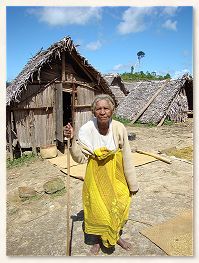
Village
in Diego Suarez
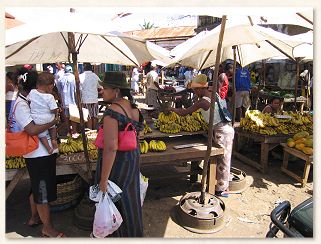
Diego
Suarez Market
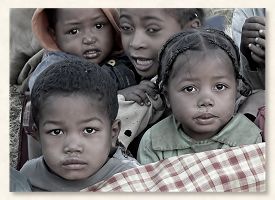
Malagasy
Children
Missions Trip to Madagascar
Reminder
Since
the Hamiltons will be traveling back to the US this fall and winter,
we have changed our trip date to July of 2008. We are going first
and foremost to be a blessing to the Hamiltons. While there, we hope
to put on one or more "workshops" for the midwives and other medical
professionals in and around Diego. In addition, we would like to
bless the medical professionals with a gift that will help them in
their practice. Please pray for David, Deborah, and Kristin as they
seek God's direction for the specific topics to address in the
workshop(s). Also pray to see whether or not God would have you join
us on this adventure. It will, no doubt, change your life as you go
to serve the Hamiltons and the Malagasy people. We will have the
official "sign-up" at the beginning of 2008. More details to come.
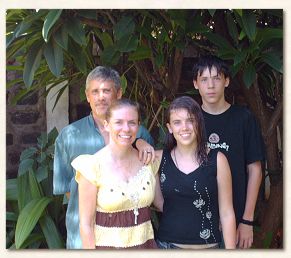
David, Deborah, MarLee and Liam Hamilton
|
Tidbits from EBONY
Birth In Ebony
Dear Charis Friends,
Imagine a building with electricity
that comes and goes, dirty water backed up in sinks, unsanitary
latrine facilities and the smell of bleach burning the nostrils of
the visitors. That is what Ebony hospitals and clinics seem like to
me. Of course, each one is different. In the city of Candybar,
(the city in Ebony where I reside), local people say the hospital is
not a place where you go to be healed, it is the place you go to
die. People must bring their own supplies for any procedure at the
hospital. For a C-section, women bring their own string for
knitting wounds, their own IV equipment bought at a dirty bazaar
downtown, etc.... Really, there are very few of the amenities we
think of at the hospital. It is also said in Candybar that, if a
woman must have a C-section as a last resort, she will go to the
hospital and the doctor will say to the family, “Which one do you
want me to let live—the mother or the baby?” It is assumed that
both would not make it out alive. When I have visited hospitals in
Ebony, they have been packed with people who receive very little
care for their conditions. The most effective care occurs in small
clinics which are not government funded and which are located
throughout communities. These kinds of clinics often treat problems
that were incurred originally at the hospitals. There is one
hospital in Ebony that I know of that has adequate healthcare for
most situations—including those related to pregnancy and
childbirth. This hospital is located in the capital city of the
country, however, and is logistically inaccessible to the women of
Southern Ebony. So most babies are not born in the hospitals
or clinics there.
When a woman is ready to give birth,
she usually states that she is not feeling well and will then
retire to a private room in the home. Every family is different,
just like in our culture in the West. Sometimes a mother-in-law or
sister attends the birth and helps with pain management, spiritual
issues, and care for the newborn. Often (about 50% of the time or
more) a woman is expected to deliver alone. There is a saying in
Candybar that when a woman goes into labor, she goes into the closet
and shuts the door and she either comes out or she doesn’t. Among
the nomadic peoples, women are especially shy and view their bodies,
and the birth process, as shameful and dirty. They will deliver
their babies along the road or in a field while their tribe travels
on ahead of them. I have been told that, after some hours, the
father of the baby will send a donkey back for mother and child to
ride on until they catch up.
If you were to ask a family in Ebony if
Father’s attend births, they would say “No” every time. But, I have
heard stories from men who became involved when an emergency
occurred. One such situation was when a mother began hemorrhaging
during labor. The father did not know what to do, so he tied her
onto a board or mattress and positioned it against the wall so that
she was hanging upside down. There is an extreme need for education
among both men and women in Ebony about basic principles of health,
hygiene, first aide, prevention, etc.... Fathers generally are not
interested in learning about women’s health or supporting
initiatives within the community focused on this subject. But, a
movement has begun in the Northern part of the country among men who
are realizing that it is possible to prevent the deaths of their
babies and wives. They are becoming more interested and
knowledgeable. They may never reach the point where they consider
it acceptable to attend births, but I pray that in our lifetime they
will begin to participate in protecting and saving the lives of the
women and children of their families and their country.
Prenatal care is virtually
non-existent. It consists of women being given instructions from
their mother-in-law or some other older woman. Sometimes this
information can be right and helpful, but many times they simply
receive false information and training in how to ward off evil
spirits which are viewed as the cause of all health problems.
Prenatal care is one of the keys to changing the infant and maternal
mortality rates in Ebony and it is becoming one of my passions!
It seems that during labor and delivery
many things come naturally to the women of Ebony—positions, noise
making, etc.... After birth, babies are sometimes allowed to root
and nurse. They are kept close to their mothers. They are held and
loved on and sleep with their mothers for up to forty days of rest.
One of the most important aspects of infant care in Ebony is to
dedicate the baby, at birth, to the religion of Islam. The faith
confession of Islam is whispered into the baby’s ear by his/her
father or a religious leader VERY soon following birth. I believe
this is a spiritual stronghold of the region and am honored that
some day I may have the opportunity to pray protection and
dedication to the One, True God before this Islamic ritual occurs in
their young life. There are many misconceptions surrounding infant
care in Ebony. One that is heavy on my heart is the myth among
women that colostrum is “sour milk.” They view it as milk that is
nine months old. Some women let their babies nurse anyhow, but
others are known to starve their babies for the first few days until
milk comes in. Sometimes, they start them off with formula that has
been donated as a free gift to the family. The family does not have
money to buy more formula so, in order to make it last longer, they
water it down until their is virtually no nutritional value at all.
Often, formula is mixed with dirty water, so babies end up dying of
dysentery before they die of malnutrition. I am sorry to seem so
gloomy here, but with the highest infant mortality rate in the
world, there is very little uplifting news to offer.
There are differences in the areas of
Ebony. As you would expect, the further away from an urban area and
the less financially affluent the family, the more deaths occur.
The sad thing is, whether in the city or in rural areas, many of
these deaths are preventable. My passion is to spend the next
several years learning more about this land and people and teaching
local women to train others themselves in principles of prenatal and
infant care so that they can have some hope and success in
childbirth.
Well, I hope my uplifting and succinct
lecture here has just caused all of you to feel called to come work
with me in Candybar!!! :-) I won’t object!!! :-) In all
seriousness, please, please continue to pray for the situation in
Central Asia—that, by the mighty hand and mercy of God, hope and
life would be brought to the women under the veil.
All my love,
Elizabeth Carmichael
Children
in Ebony
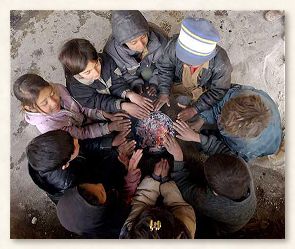
Keeping warm ... Ebony refugee children
gather around a fire at a refugee camp. Ebony is one of the world's
poorest places, ranking 173 out of 178 countries, a development
survey said.
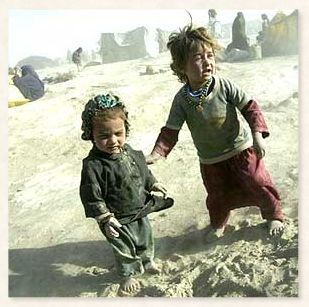
Many Ebony children have moved to
refugee camps because their homes have been destroyed.
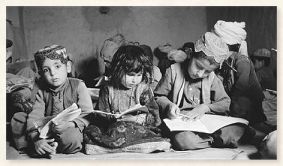
A group of Ebony children.
Although
education is valued in Ebony, only 5 percent of Ebonian children
receive a primary education.
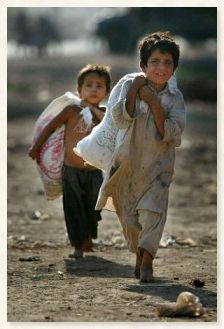
Children in Ebony
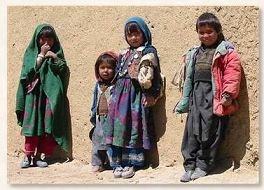
Children
waiting to be seen at a clinic in Ebony
|