|
Pregnancy and
Birth
Staying Home to Give Birth:
Why Women in the United States Choose Home Birth
Debora Boucher, CNM, Catherine Bennett, RNC, BSN,
Barbara McFarlin, CNM, PhD, RDMS, and Rixa Freeze, PhD, MA
Approximately 1% of American
women give birth at home and face substantial obstacles when they
make this choice. This study describes the reasons that women
in the United States choose home birth.
A
qualitative descriptive secondary analysis was conducted in a
previously collected dataset obtained via an online survey. The
sample consisted of 160 women who were US residents and planned a
home birth at least once. Content analysis was used to study the
responses from women to one essay question: ‘‘Why did you
choose home birth?’’
Women who participated in the study were mostly married (91%) and
white (87%). The majority (62%) had a college education. Our
analysis revealed 508 separate statements about why these women
chose home birth. Responses were coded and categorized into 26
common themes. The most common reasons given for wanting to birth at
home were: 1) safety; 2) avoidance of unnecessary medical
interventions common in hospital births; 3) previous negative
hospital experience; 4) more control; and 5) comfortable, familiar
environment. Another dominant theme was women’s trust in the birth
process. Women equated medical intervention with reduced safety and
trusted their bodies’ inherent ability to give birth without
interference.
INTRODUCTION
Modern hospitals have undergone tremendous technological advances
and patient-focused changes over the past 50 years, culminating in
facilities that offer world-class care, patient safety, and
compassionate attention. In particular, maternity units have been
replaced with family-centered birthing suites outfitted with the
latest machines and patient amenities. Despite this safe and
seemingly comfortable environment, a small but steadfast population
of American women chooses to decline the hospital setting to give
birth in their own homes.
Before the mid-20th century, most American women gave birth at home
under the care of midwives. As the specialty of medical obstetrics
grew, the percentage of hospital-based births increased. In 1940,
40% of births to white women and 73% to nonwhite women in the United
States occurred at home. Total hospital births were 56% in 1940.
In 1950, the percentage of hospital births soared to 88%, rising to
more than 99% by 1969, where it remains today. Therefore, the small
percentage of the population of women choosing home birth in the
United States today comprise a minority culture. Although the
percentage of home births has remained below 1% since 1960, the
actual numbers are not trivial. National figures for 2005 show that
24,468 infants were born at home in the United States. The
majority of women who chose home birth in the United States were
white and were attended by midwives.
Numerous studies have shown equivalent safety rates when comparing
home and hospital births. A recent integrative review compiled
data from 28 studies undertaken between 1969 and 2000.
Fullerton et al. concluded that maternal and neonatal outcomes of
planned home birth receiving first-level care were favorable when
compared to planned hospital or birth center births. A meta-analysis
of six studies comparing the birth outcomes of 24,092 low-risk
pregnant women found that perinatal mortality was similar between
the home and hospital birth groups. Olsen found that the home birth
group had a decreased frequency of induction, augmentation,
episiotomy, operative vaginal birth, and cesarean delivery.
Despite
favorable safety rates, the choice to have a planned home birth is
not well supported in the United States by the government,
professional organizations, the insurance industry, or society.
Government regulations impede practitioners from providing home
birth services by limiting licensure. All states license physicians
and advanced practice nurses, but only 23 states allow licensure of
non-nurse certified midwives who are more likely to attend home
births. Recently, the American College of Obstetricians and
Gynecologists issued a news release reiterating its opposition to
home birth as stated in their 2006 Statement of Policy, which
admonished physicians from practicing home birth and from providing
back-up support for home birth providers. These
regulations and policies result in small numbers of home birth
providers and great difficulty for women in locating a provider.
Some insurance companies do not fully reimburse providers’ fees for
home birth. In addition, women who choose home birth are often
asked questions about the perceived risk they are taking.
Studies from other countries where home birth is more prevalent
examined reasons why women chose home birth. Common themes were
control, comfort, freedom to move, and fewer interventions. In
two of the four studies, women stated that they felt safer at home.
In Turkey, although the main reason for choosing home birth was
economic, almost 50% of the women stated that they feel more
comfortable at home. Given that women choosing home birth in the
United States are a minority population, and that their choice to
birth at home is not well supported, the aim of our study was to
describe the reasons why women choose home birth.
METHODS
Study Design
This qualitative descriptive study sought to examine why women in
the United States choose home birth. The study consisted of a
secondary content analysis of one question from a larger dataset
collected for a study entitled, ‘‘A New Look at Homebirth in the
United States,’’ by Rixa Freeze at the University of Iowa. The
Institutional Review Boards at the University of Illinois at Chicago
(UIC) and the University of Iowa reviewed and approved the study’s
intent and protocol. The online survey was advertised via e-mails
and postings on Internet electronic mailing lists for childbirth
professionals and via direct solicitations to known childbirth
professionals who provide home birth services. Solicited home birth
providers forwarded the advertisement to their patients, requesting
volunteers to respond to the survey, which was made available online
from August 2006 through May 2007. The data were collected in an
Excel spreadsheet. After the survey was closed, the data were
de-identified and provided to the UIC research team.
The conceptual framework that guided this research was Leininger’s
cultural care diversity and universality theory. The goal of
Leininger’s theory is to ‘‘provide culturally congruent nursing care
in order to improve or offer a different kind of nursing care
service to people of diverse or similar cultures.’’ This theory
applies to the subjects of our study because the small population of
women who choose home birth could be considered a cultural group.
Essential to Leininger’s theory is the need for nurses to appreciate
how the individual woman views her own health status. This framework
can be extended to include an understanding of why women would
choose to give birth at home and not in the hospital. This project
sought to identify the reasons why women choose home birth. We
anticipated that several themes would emerge during data analysis,
which may help health care providers provide culturally competent
care to this cultural group.
Sample
A convenience sample of 160 women who completed an online survey about home birth was selected from 272 respondents
who completed an online survey about home birth.
Responses were selected if the respondent was a woman who had
planned to give birth at home in the United States at least one
time. Responses were excluded if the respondent planned only to
birth in a birthing center or hospital, was not a woman, or was not
a resident of the United States.
Measures and Data Collection Procedures
The original online survey consisted of 30 questions authored by
Rixa Freeze. The subset of data used for this study included one
open-ended question ‘‘Why did you choose homebirth?’’ and six
demographic questions: ‘‘State of residence,’’ ‘‘Gender,’’ ‘‘Age,’’
‘‘Your occupation and education level,’’ ‘‘Place and manner of your
children’s births,’’ and ‘‘Involvement with birth.’’ The majority of
responses to the question ‘‘Why did you choose homebirth?’’ were
brief; all 160 responses were analyzed.
Data Analysis
The de-identified data were collected using Excel, with rows
representing the respondents and columns representing the questions.
A coding subset was created containing only the respondent’s
identification number and the responses to the key study question
‘‘Why did you choose homebirth?’’
Themes
Responses to the study question ‘‘Why did you choose homebirth?’’
were numerous. Most of the 160 respondents stated several reasons
for planning a home birth. Descriptions of the 26 common themes and
the coding rationale and the frequency distribution of coded themes
are found in Tables 1 and 2 in the study. The five most frequently
identified themes will be discussed in this paper: ‘‘safety and
better outcomes,’’ ‘‘intervention-free,’’ ‘‘negative previous
hospital experience,’’ ‘‘control,’’ and ‘‘comfortable environment.’’
Nine out of the 30 respondents who mentioned ‘‘comfortable
environment’’ also mentioned ‘‘trust in birth’’; therefore, the
‘‘trust in birth’’ theme will also be discussed.
Safety and Better Outcomes
Twenty-four percent of the respondents reported that their reason
for planning a home birth was their belief that home was the safest
place to give birth and allowed the opportunity for better health
outcomes. The following comments exemplified these beliefs:
‘‘We felt
[that] homebirth was the safest option for us."
‘‘Later, I learned about the risks of
homebirth vs. hospital birth, and felt that in my situation I
had a far better chance at a good outcome at home.’’
Only three of the 38 women who listed safety and better outcomes as
a reason for choosing home birth also reported a negative previous
hospital experience. Seven of the 38 women reported that it was
better for the baby’s health to birth at home.
Professionals represented the largest occupational group that
reported safety and better outcomes, and four of the professionals
were health care practitioners.
Other occupations represented in this theme were homemakers,
service, management, students, and sales. Most of the women had
attended college, and many had completed a bachelor’s degree or
higher.
Intervention-Free
The other most frequently identified theme involved the use of labor
and delivery interventions. Twenty-four percent of the
respondents discussed their desire to avoid medical interventions,
routine procedures, and interferences that are common in hospitals.
Some women described specific interventions that they would like to
avoid, and other women referred to interventions that occurred
during a previous hospital experience that they were hoping to
avoid:
‘‘No: monitors,
IVs, drugs, laying on my back, family pushed away, baby taken away,
baby given sugar water.’’
Some women focused their comments on avoiding interference in the
birth process:
‘‘I believe
birth, it proceeds best when un-interfered with.’’
Twenty-four percent of the respondents who mentioned safety as a
reason for choosing home birth also stated that they preferred their
birth to be intervention-free. Women who expressed both safety and
intervention-free themes shared this typical responses:
‘‘I realized that
*my* home [is] a safer environment for my babies than a hospital
room. As far as I am concerned, lower intervention means higher
safety for both mother and baby.’’
Negative Previous Hospital Experience
Another theme that was frequently mentioned was a negative previous
hospital experience:
‘‘In my first birth
experience, I felt bullied, robbed, cheated, and fearful in the
hospital environment. I could not use my voice in the hospital and
my doctor did not listen anyway. I was a passive patient, instead of
an active participant.’’
Many chose home birth after observation of someone else’s negative
hospital experience:
‘‘I had seen such
bad experiences through family and friends of mine with hospital
births that I really wanted to do a homebirth.’’
Control
Many women wrote about wanting control of their birthing experience.
They expressed a desire to be the primary person making decisions
and choices regarding treatment and care:
‘‘To create a
situation where I had a great deal of freedom and control over the
birth process without the restriction imposed by hospital
policies.’’
Comfortable Environment
Giving birth in an environment described as comfortable, calm,
peaceful, loving, or familiar was a theme that was mentioned as a
priority to many of the women in this study:
‘‘I wanted to bring
my baby into a peaceful and familiar environment surrounded by love
and support.’’
One-third of the respondents in this group also expressed the eighth
most common theme, ‘‘trust in birth.’’ They remarked that birth
would proceed more normally in a home environment than in a hospital
environment. We include this theme because of the frequency of its
occurrence within this group’s statements:
‘‘I knew [that] I’d
feel more comfortable at home and I would therefore labor better.’’
Listening to Mothers II
(LTM-II), a national US survey of women’s childbearing experiences,
found that interventions have become routine in hospital settings,
including electronic fetal monitoring (94%), medications for pain
relief (86%), and epidural analgesia for vaginal deliveries (71%).
Nearly one-third of hospital births in 2005 were cesarean
deliveries. LTM-II concluded that ‘‘large proportions experienced
numerous labor and birth interventions of benefit for mothers with
specific risk conditions, but inappropriate as routine measures.’’
Routine labor interventions experienced by women delivering in
hospitals are not evidence-based and do not reflect best practice.
It is not surprising, then, to hear women express a desire to birth
at home to avoid interventions that they may have experienced or
witnessed at previous births, especially when women do not feel that
their preferences would be honored.
Many of the women’s
responses specifically acknowledged the impact of former negative
birth experiences.
The hurt and frustration were apparent in their responses. Also
voiced in their comments was the positive impact that their decision
to have a home birth had on their families, their babies, and
themselves. This echoes the findings of LTM-II, which examined
research focused on the lifelong implications and the impact of the
birthing process on both infants and mothers.
Institutions have policies and procedures intended to safeguard the
well-being of the institution and those it serves.
In some instances, the control of the institution comes in direct
conflict with the power and control of the individual. In our study,
35 women stated that one of the issues that influenced their
decision to have a home birth was their desire to have increased
control of their birthing experience. Words used were: ‘‘freedom,
control, autonomy, and lack of hospital-imposed
restrictions’’—concepts that they felt were only available to them
in their own home. In contrast, words used by women in LTM-II when
describing their feelings about their hospital birthing experience
were ‘‘overwhelmed’’ (38%) and ‘‘frightened’’ (33%), while only 17%
described feeling ‘‘powerful’’ during the labor process. Thirty of
the women in our study remarked that their home birth decision was
based on wanting to give birth in a comfortable, familiar, peaceful
setting where they would be better able to relax during labor. Many
of them also upheld their belief that this relaxed state contributed
to a normal progression of labor, which results in shorter labors.
Extensive research supports the hypothesis that increased
epinephrine levels that occur with anxiety during labor are
associated with an increase in the length of labor.
IMPLICATIONS
The goal of our study was to categorize and describe common themes
among the culture of women choosing home birth and to provide an
understanding of the depth of reasons included in this very personal
decision. We used Leininger’s theory of cultural competence to
explain the need for health care professionals to appreciate how the
individual woman views her own health status. Through appreciation
of the insight and personal expressions shared by women, the
implications for practice apply to midwives, physicians, obstetric
nurses, and perhaps most importantly, to women of childbearing age
whose health status is affected by the childbirth process. Midwives
and physicians who attend home births can use this information to
further support the necessity for continuing the home birth portion
of their practice.
There is clear evidence that hospital obstetric units in the United
States are not providing evidence-based maternity care, appropriate
care for low-risk women, labor support techniques for pain relief,
nor support for the natural ability of low-risk women to give birth
vaginally without technological interventions. The insight provided
by the women in our study, combined with the responses from LTM-II,
could provide motivation for hospitals to evaluate their current
practices and begin to implement protocols that better reflect
current evidence-based research and women’s desired preferences.
Our research can provide a framework to assist hospital obstetric
nurses and physicians in providing culturally competent care to
women who divert from their planned home birth when a transfer to
the hospital is necessary.
The women in our study were concerned about safety and
interventions, not unlike the women of the LTM-II study who planned
to deliver in the hospital. Unlike the women in LTM-II, who reported
that they did not possess the knowledge to make informed birthing
decisions concerning risks and benefits of interventions, many of
the women in our study felt that routine obstetric interventions
were not safe and made a careful choice to birth at home.
In summary, our data on ‘‘Why did you choose homebirth?’’ and the
data from LTM-II have shown that women in the United States who have
a strong desire for a natural birth without exposure to
technological or medical interventions have few alternatives. We
know that more than 99% of births in the United States occur in a
hospital, and more than 90% of those women experienced
interventions, even though 50% of them believed that the birth
process should not be interfered with unless medically necessary.
Given these inconsistencies, one might be better able to understand
why low-risk women who want to labor without interventions choose
home birth.
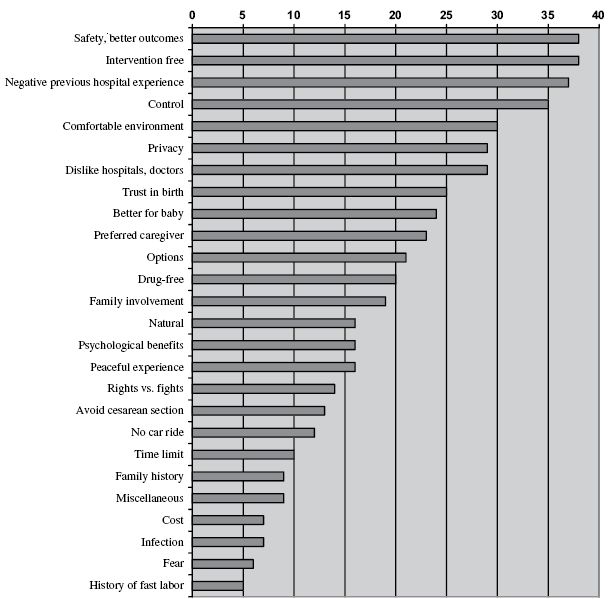
Graph: Number of responses from each of the 26 themes that emerged
from analysis of the question,
"Why did you choose home birth?"
CONCLUSION
The women in our study have provided thoughtful insight into the
very personal reasons why they planned to deliver their children at
home. Their survey responses illustrate that they do care about
safety, that they desire a natural birth experience without medical
interventions, and that they wish to feel that they are in control
of their birth. Women in our study trusted the inherent abilities of their bodies to give birth
without interference, in the environment of their own conception.
According to our respondents, there is no place like home for a
safe, comfortable, peaceful, relaxing birth.
REFERENCES
1. Cassidy T. Birth: The surprising history of how we are born. New
York: Atlantic Monthly Press, 2006.
2. Sears W, Sears M. The birth book. Boston: Little Brown and
Company, 1994.
3. Midwife and out-of-hospital deliveries. United States. Vital
Health Stat 21 1984.
4. Martin JA, Hamilton BE, Sutton PD, Ventura SJ, Menacker F,
Kirmeyer S, et al. Births: Final data for 2005. Natl Vital Stat Rep
2007.
5. Wertz R, Wertz D. Lying-in: A history of childbirth in America.
New Haven, CT: Yale University Press, 1989.
6. Ackermann-Liebrich U, Voegeli T, Gu¨nter-Witt K, Kunz I, Zu¨ llig
M, Schindler C, et al. Home versus hospital deliveries: Follow up
study of matched pairs for procedures and outcome. Zurich Study
Team. BMJ 1996.
7. Fullerton JT, Navarro AM, Young SH. Outcomes of planned home
birth: An integrative review. J Midwifery Womens Health 2007
8. Johnson KC, Daviss BA. Outcomes of planned home births with
certified professional midwives: Large prospective study in North
America. BMJ 2005.
9. Murphy PA, Fullerton J. Outcomes of intended home births in
nurse-midwifery practice: A prospective descriptive study. Obstet
Gynecol 1998.
10. Olsen O. Meta-analysis of the safety of home birth. Birth 1997.
11. Anderson RE, Murphy PA. Outcomes of 11,788 planned home births
attended by certified nurse-midwives. A retrospective descriptive
study. J Nurse Midwifery 1995.
12. Midwives Alliance of North America Web site. Direct entry
midwifery state-by-state legal status. Available from: www.mana.
org/statechart.html [Accessed November 25, 2007].
13. American College of Obstetricians and Gynecologists. ACOG
statement on home births. Washington, DC: American College of
Obstetricians and Gynecologists, 2008.
14. American College of Obstetricians and Gynecologists. ACOG
statement of policy: Out-of-hospital births in the United
States. Washington, DC: American College of Obstetricians and
Gynecologists, 2006.
15. Hartley H, Gasbarro C. Forces promoting health insurance
coverage of homebirth: a case study in Washington State. Women
Health 2002.
16. Davies J, Hey E, Reid W, Young G. Prospective regional study of
planned home births. Home Birth Study Steering Group. BMJ 1996.
17. Fordham S. Women’s views of the place of confinement. Br J Gen
Pract 1997.
18. Kleiverda G, Steen AM, Andersen I, Treffers PE, Everaerd W.
Place of delivery in The Netherlands: Maternal motives & background
variables related to preferences for home or hospital confinement.
Eur J Obstet Gynecol Reprod Biol 1990.
19. Soderstrom B, Stewart PJ, Kaitell C, Chamberlain M. Interest in
alternative birthplaces among women in Ottawa-Carleton. CMAJ 1990.
20. Kukulu K, Oncel S. Factors influencing women’s decision to have
a home birth in rural Turkey. Midwifery March 15, 2007 [Epub ahead
of print].
21. Leininger M. Culture care theory, research, and practice. Nurs
Sci Q 1996.
22. Sandelowski M. Whatever happened to qualitative description? Res
Nurs Health 2000.
23. Miles MB, Huberman AM. Qualitative data analysis: An expanded
sourcebook, 2nd ed. Thousand Oaks, CA: Sage Publications, 1994.
24. Hildingsson IM, Lindgren HE, Haglund B, Radestad IJ.
Characteristics of women giving birth at home in Sweden: A national
register study. Am J Obstet Gynecol 2006.
25. Madi BC, Crow R. A qualitative study of information about
available options for childbirth venue and pregnant women’s
preference for a place of delivery. Midwifery 2003.
26. Declercq E, Sakala C, Corry M, Applebaum S. Listening to mothers
II: Report of the second National U.S. survey of women’s
childbearing experiences. New York: Childbirth Connection, 2006.
27. Sakala C, Corry MP. Listening to Mothers II reveals maternity
care quality chasm. J Midwifery Womens Health 2007.
28. Field T, Hernandez-Reif M, Hart S, Theakston H, Schanberg S,
Kuhn C. Pregnant women benefit from massage
Journal of Midwifery & woman's Health
View complete article
If you need Adobe PDF Reader:


'Behold, I will bring them from the north country, And gather them
from the ends of the earth,
Among them the blind and the lame,
The woman with child and The one who labors with child, together,
A
great throng shall return there...And My people shall be satisfied with My goodness, says the LORD.'
Jeremiah 31:8, 14~~~
©2009 Charis Childbirth
Services, All Rights Reserved
Feel free to forward this newsletter to friends in its entirety,
leaving all attribution intact.
March 2009
|