|
Adventures In Madagascar
Maventibao Village
Hello
Charis Family,
I recently spent 7 days in the village, Maventibao. We're not
completely sure that's where we're supposed to be. The village is
only there because a big mining company came in looking for
sapphires. And wow, did they find them. They left huge earth-scars
and when the big sapphire finds ran out, they ran out too. While the
town was "booming", people from all over Madagascar came to make
their fortunes. (Sorta' like the Gold Rush days in CA.) Now the
unemployed miners left behind go into the mountains with their 7-12
year old children every day to dig holes hoping to find a few
sapphire shards. They turn them in for just enough money to buy
2-days worth of rice and dried fish, usually.

Maventibao Villagers
The
village seems very fractured, not at all like a normal Malagasy
village. They have built fences to divide the village into tribes or
units. Normally, everybody likes everybody else and they all work
together to help with children, food, & building houses-- they share
what little they have with others. Not in Maventibao! Each family
looks out for their own. EX: This one doesn't like that one because
they're from the highlands and highlanders treated their ancestors
like slaves, and that one doesn't talk to the others because they're
all peasants from the east or west coasts. They are uneducated and
don't know how to speak their own language.
We believe there is a huge ministry in Maventibao. We'll be praying
about it until we get an answer from God about whether he wants us
in Maventibao or not. I feel very torn about this village. On one
hand, the only clinic within 30 miles is in Maventibao.

Maventibao Clinic
Ben, the
American who started the clinic, has created a 9 village network.
Every village in the network comes though Maventibao to sell their
rice and to get medical treatment. On the other hand, we are called
to the Antakaran and there is not one person living in Maventibao
that's Antakaran. Then too, I have only been to 2 villages within
the network so maybe there are Antakaran I don't know about. We must
seek God's guidance; we don't want to get involved there and
potentially mess up His plans for us...and them. However, there are
so many needs in northern Madagascar, how can we say 'No' to a
request to come and build a church. Please pray for us as we seek
God's guidance in this huge decision!
Our time here prior to our furlough is getting very short. We'll be leaving Diego on September
1st. David has meetings to attend with the Anglican Church in Tana
and the kids want to have time to visit their friends before we
leave on the 7th. We arrive in CA on the 8th and will be in
debriefing for 5-6 days. On the 20th we'll be driving to Portland,
OR, for a church presentation. Then for about 2 weeks we visit
family scattered throughout the west. From there it gets a little
fuzzy. We may have a few visits in TX but haven't heard back from
them on dates. We'll keep the same email address and be checking in
as often as we can. We don't know exactly when we'll be headed east
but we want to visit family and the Schuchmanns' church in FL. We
think we'll be in Virginia Beach about the 20th of October.
Sorry the schedule isn't more solid, but missionaries must be
flexible.
Please pray for us. Things are getting a little stressful as we make
arrangements to close the house here, find someone
responsible to pay our guards while we gone, and travel half way
across the world. Thank-you!!
God's Peace,
Deborah
Missions Trip to Madagascar
Reminder
Since
the Hamiltons will be traveling back to the US this fall and winter,
we have changed our trip date to July of 2008. We are going first
and foremost to be a blessing to the Hamiltons. While there, we hope
to put on one or more "workshops" for the midwives and other medical
professionals in and around Diego. In addition, we would like to
bless the medical professionals with a gift that will help them in
their practice. Please pray for David, Deborah, and Kristin as they
seek God's direction for the specific topics to address in the
workshop(s). Also pray to see whether or not God would have you join
us on this adventure. It will, no doubt, change your life as you go
to serve the Hamiltons and the Malagasy people. We will have the
official "sign-up" at the beginning of 2008. More details to come.

David, Deborah, MarLee and Liam Hamilton

The
Highlands
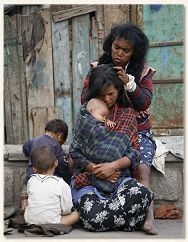
A woman
picks head lice from another
on a street in Antananarivo
|
Tidbits from EBONY
Marriage
in Ebony
Dear Charis Friends,
Greetings from Colorado! I am high up in the mountains at a training
seminar focused on community development projects in Ebony. I am
learning so much and it makes me even more excited to get back to
the field!!! You can be praying for me this month that:
• God would allow my support base to increase so that I have the
finances to be able to return to Ebony in November or December
• He would provide more opportunities to serve women in birth
• He would prepare me mentally, emotionally, physically and
spiritually to serve Him for this next three year term in Ebony
Since marriage is the theme, I thought I would try to
share a little about marriage in Ebony! I even found an article that
I have included to give you some more insight into the culture.
Typically, women in Ebony marry at very young ages—some as young as
9 or 10, although it is more common to marry at around age 16. Women
are immediately pressured to begin childbearing. Some women have
taken their daughters to the hospital to receive shots of oxytocin
so that they will begin menstruating earlier and, therefore, able to
be married off to bear children. Unfortunately, the result we are
seeing is women in their 30’s who are entering menopause when they
should still be able to bear children for several more years. This
is tragic for these women since they are taught by their culture
that their ONLY value in life is to bear children, especially sons.
In Ebony, marriage is basically an economic transaction between the
two families arranging the marriage. The “meaning” of the marriage
revolves around childbearing. Women who are barren are cast off and
viewed as useless. Any time a couple is unable to conceive, it is
always the “fault” of the woman.
A man in Ebony can be married to, at most, four women at one time.
Many men cannot afford to support this many women and the children
they bear, so they might only marry one or two. It is very, very,
very rare that a marriage consists of two individuals who love and
value each other, although I have seen this on one or two occasions.
A marriage in Ebony is quite a celebration!!! During the previous
oppressive regime, however, all music was banned and women
especially were prohibited from gathering together to celebrate a
marriage. Ebony culture, however, is very creative, artistic and
expressive, so, more recently, families have been able to truly
celebrate these unions the way they desire to!
As a single woman in Ebony, people are CONSTANTLY trying to marry me
off! It is common in most Central Asian cultures to be looked down
upon as a single woman. I have gotten used to this over the years and I
try to come up with some serious answers and some funny
ones—depending on the context of the question or comment. One Muslim
man I met one time told me all about his family and his two wives
and then asked about my husband. I told him I didn’t have one and he
said, “I’ll take you!” Without missing a beat, I quickly retorted,
“Too bad I won’t take YOU!” He wasn’t offended, just as he did not
mean to be an offense. Some ways of thinking are just where they are
at as a culture and I have to approach them with respect and love,
patiently waiting for them to know the Truths that will set them
free.

When Ebony women get married,
they often decorate their hands and their bodies
with henna “tattoos.”
Sometimes when I speak to different groups I show them the veil I
wear in Ebony. You have seen pictures of it in previous editions of
the newsletter. What I like to do is explain that the veil, to me,
represents where the people of Ebony are at in their spiritual
journey. Their hearts and minds are blinded from the glory of God in
the face of Jesus (see 2 Corinthians 4). But, then I like to pull
out my Ebony wedding dress that I purchased on my first trip in
country. I am sorry I don’t have a picture of it for you!! It is a
bright green dress with sparkly sequins hand sown all over it!! The
women wear green because, to them, it represents “new life.” Little
do they know what those words mean to me and what I hope for them! I
hold the wedding dress up in front of the group I am speaking to and
I encourage them that some day women from Ebony will stand before
the Throne of God wearing this kind of dress. They will be married
to the Lamb and will be free from physical and spiritual oppression,
both. So, we pray acknowledging the reality of the veil over their
hearts, but we also pray in hope and faith that the wedding dress
represents the transformation our Father wants to make in their
lives! Please pray as you read the following article detailing an
Ebony wedding.
Marjan's Wedding: A Time for Celebration
By Cassandra Nelson
Sohaila's home is a hive of activity.
Women are busy cooking over open fires in the courtyard. Children
chase the goats and sheep that have been brought in from the pasture
to be slaughtered and cooked for the evening's feast. It is the day
Sohaila's sister is getting married, and everyone is preparing.
"Family has come from J. and even as far away as the capital for my
sister Marjan's wedding celebration," says 13-year-old Sohaila, who
is clearly excited about the evening's activities.
"There are over 40 people staying in our home. Tonight we are
slaughtering two sheep for a barbecue, and my uncle will play the
ribab [a traditional Ebony stringed instrument]."
The family is the center of Ebony life, and marriages are a cause
for great celebration. Like almost all marriages in Ebony, Marjan's
is an arranged marriage.
"My mother and aunt were responsible for finding my husband," says
Marjan. At age 16, Marjan is marrying her first cousin, a very
common practice.
The process of finding a suitable mate starts very early in a young
girl's life. Marriages are often agreed upon before a girl turns 10,
but typically the wedding does not take place until a girl is 15 or
16 years old.
The women of the girl's family initiate the process. They meet with
female friends and relatives to discuss possible marriage
candidates.
Many factors are taken into consideration before making a selection:
family status, financial security, and the personalities of the
bride and prospective grooms. When Marjan's mother and aunt decided
on a groom candidate, they presented their choice to Marjan's father
and uncles for approval. The men, agreeing on the candidate, set to
work to make the financial agreement with the groom's family.
According to local tradition, every marriage requires two exchanges:
• A dowry brought by the bride to the husband's home. The dowry
includes household items the couple will need for their future life
together.
• And the mahr, the price the groom's family must pay for the girl's
hand in marriage. The mahr typically consists of livestock,
property, and money.
At the evening celebration, the women all sit together inside the
courtyard. The men are in the hujara, a large room with Ebony
carpets and pillows on the floor. The hujara is traditionally where
the men sit. In Ebony and other traditional Islamic cultures, it is
customary to have men and women separated at social events.
A large meal of kababs (grilled meat on skewers), nan (Ebony bread
that is flat and oval-shaped), subzi (stewed vegetables), and pilau
(rice cooked with meat) is served to the guests first. As is
dictated by the Pushtun tradition of hospitality, the hosts will not
eat until after the guests have had their fill.
Finally, the music begins. Marjan is sitting with her sisters and
cousins. She is beaming with happiness. "I am very grateful. They
have chosen well for me," she says, referring to her family's choice
of her husband. "And, inshallah [God willing], we will be blessed
with a child soon."
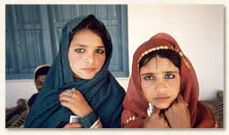
Sohaila and her cousin
dressed in their best clothes and jewelry
before the wedding.
|