|
Charis Around
The World
Birth Houses in
Ukraine
Shared by Charis student Anne Sokol who lives in Ukraine with her husband, Vitaliy
and their two precious little girls, Victoria and Skyla.

In
Ukraine, women give birth in a “birthhouse.” These are located
regionally, and unless she makes other plans, she will birth in
the birthhouse in her region. Only births are in this building.
For prenatal care, she visits her local clinic. The staff are
also separate, so whereas in the States, we have an ob/gyn,
in Ukraine the prenatal/women’s health care doctor is called a
gynecologist, not an obstetrician.
Birthhouses in Ukraine are run by the government. They are not
private and do not have insurance programs. While we may think
this is great initially, it’s actually not better as a system.
Women have very little to no say about how they are treated and
what is done to them. Informed consent is not an issue here. The
staff mostly just does as they like.
Some women make private arrangements with an ob before her
birth. She pays him to have a good experience and care, perhaps
to have her husband present (very rare here), and maybe for some
other agreements. Paying the staff, too, is also helpful to how
she will be treated. Sometimes the nurses and other staff will
withhold things unless they are paid.
Aside from other birthing women and the staff, women usually
birth alone. Family members aren’t allowed. Husbands are if they
pay and make arrangements beforehand. Outside the birthhouses in
some places you will see lots of graffiti on surrounding walls
where husbands have spray-painted messages for their wives to
see through the windows. By law (passed in 1996), a woman is
allowed to birth how she wants, with whomever she wants, etc.
But this law has no influence in birthhouses. If a woman tries
to site this law, she is just told that she can then birth
somewhere else if she doesn’t want to comply.
One of the effects of Communism is control issues. Very often
here, in various settings, the issue is control. An official
gives you problems because he wants to show you who is in
control. It happens the same in birthhouses. The staff is in
control. There are no niceness regulations. Good births happen.
But they don’t happen because of the system, rather in spite of
it. I have heard stories of demeaning and even cruel treatment.
Accountability is a problem. In America, insurance is a means of
accountability, though it’s not perfect. Here, if there is a bad
outcome, the birthhouse staff will find a way to cover it. For
example, the baby of an acquaintance died in a birthhouse. The
staff destroyed her hospital records and wrote that she had
birthed at home.
These days there seem to be many c-sections. There are also
regulations regarding them. For example, a woman is allowed to
only have three c-sections. During the third one, her tubes are
tied. Also, while there is a slim chance she can find a doctor
who will help her have a VBAC, by regulation, VBAC’s are not
allowed.
There are two birthhouses in Ukraine who have conformed
themselves to WHO’s Baby-Friendly standards and hold that title.
They are in Zhytomyr and Lvov. (I have personally sent several
friends there; they allow VBACs, which is rare, don’t separate
mom and baby, encourage dad’s presence, and don’t even have
birthing tables.)
I am, however, sympathetic with birthhouse staff in some
regards. They are horribly underpaid. So the fact that they take
money from their patients in a country where health care is
supposedly free is understandable. But it’s sad that money can
be the deciding factor on how they treat a woman. It isn’t
always so, but often.
Another way I sympathize with birthhouse staff is that they are
often understaffed. One or two people may be left to care for a
room of birthing women. Attentive care is almost impossible to
give in these circumstances.
Some practices that concern me are the use of catgut to suture a
c-section; routine enemas; also, I don’t know what an episiotomy
is here. If a woman has one, she literally cannot sit for at
least a month. She has to lie or stand. Some also perpetuate the
idea that a woman needs to pump her breasts after she feeds to
get all the milk out so it won’t spoil and the baby drink
spoiled milk the next feeding. There are many other such
nuances. I don’t know how prevalent this is, but one main
birthhouse in Kiev routinely uses Cytotec to induce labor
without the women even knowing. They do this illegally and don’t
chart it.
One thing I do like about Ukraine is their liberal use of herbs.
Their pharmacies are full of herbs. They also have “alternative”
ideas about health and medicine. In other ways, they are very
medical and invasive. And the more influence they have from
Western countries, the more they become technological and
drug-medicine oriented. On the one hand, ultrasound is common.
On the other hand, they use wooden Pinard Horns to listen to the
baby’s heartbeat.
Homebirth midwifery does exist in Ukraine. These midwives mostly
just conduct childbirth preparation classes then attend the
birth. They do not offer prenatal care. Their skill level and
equipment vary. This profession is basically illegal. Usually, a
homebirth midwife has a secret arrangement with a doctor, so if
there is trouble she can call the doctor to come to the house.
Or if she sees a problem coming, she can send the couple to the
birthhouse during labor, and they just say that they were trying
to birth by themselves at home.
Childbirth in Ukraine is ripe for change. Freedom, openness to
new ideas, and learning about birth in other cultures are key
ways that Ukraine is being affected. On many fronts there is
much to do. I want to be a leader in this, Lord willing, so
changes are positive and God gets glory. Pray that God will use
me in this respect.
These are photos of a big birth house in Kiev, the capitol city.

There is one large room with lots of beds where women labor.
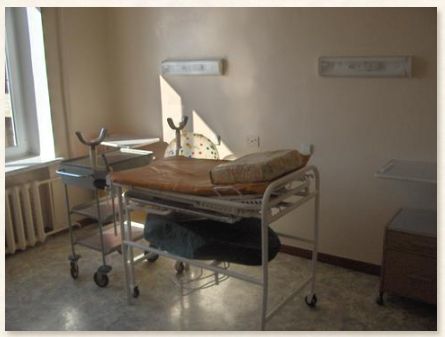
When
the woman is ready to push the baby out, she’s brought into this
delivery room.
This hospital had two birthing rooms.
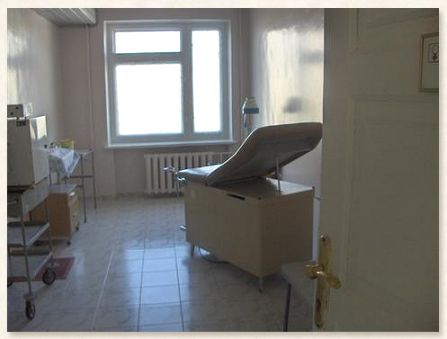
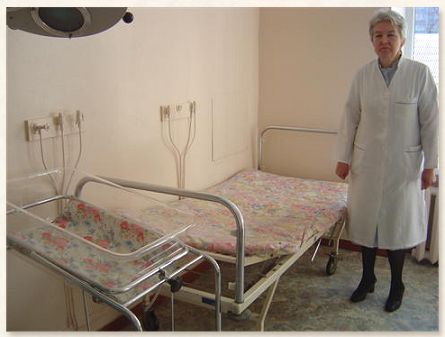
This
particular birth house had one “family” room where the husband
and wife could birth together and note the bassinet for the baby
included in the room. The labor/delivery table was in this room,
too, the now-somewhat-old-fashioned kind with stirrups. This
lady is the head of the nursing staff at this birth house. It
was she and the anesthesiologist who gave us the tour and had tea
with us.

I believe this is the c-section room.

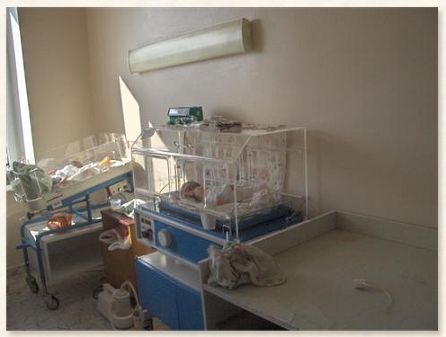
Two
pictures of the Neonatal Intensive Care Unit (NICU)
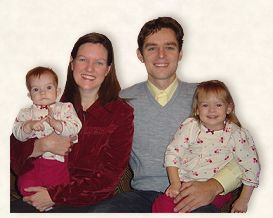
Victoria, Anne, Vitaliy and Skyla Sokol
|