|
Question of
the Month

What are the positive effects
of exercise, in particular walking, during pregnancy?
Thanks, Kathryn Lynch
Thanks
for asking, Katherine! We all know that moving our bodies
carries wonderful benefits. Certainly during pregnancy, but
throughout the rest of our lives as well! ~Susan Oshel~
Walking During Pregnancy
Walking is one the best forms of exercise
and one of the simplest and easiest ways to maintain your
physical stamina during pregnancy. It will keep you fit while your
baby lives in your womb without placing undue pressure on your joints. It
can
also increase your energy levels and improve the way you feel in
general.
Walking is an ideal activity during pregnancy because it doesn't
stress your body in any way that's unfamiliar.
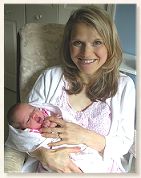
Rachel Thompson, mother of 6 precious children, finds walking an
important part of her life. Her youngest, little Tabitha
Grace, was born just 4 weeks ago. "I am an avid walker,
whether pregnant or not, and know that it has not just benefited me
physically but emotionally and mentally as well. I usually walk
about 6 times a week for about 30-40 minutes each day at a pretty
quick pace, working on getting my heart rate up somewhat. I have
noticed the energy it provides during pregnancy and I have
felt the strength it has given me to carry my pregnancies with less
discomfort and more easily and of course, my body is a little more
quick to bounce back after giving birth, also, which is an added
plus. I have just started leisurely walking again since
Tabitha's birth and feel refreshed and more energetic after my half
hour stroll."
Most
practitioners recommend that pregnant women engage in some form of
regular exercise. If you haven't exercised prior to becoming
pregnant, you might consider walking the best form of exercise
available.
Brisk walking gets your heart pumping and sends oxygen through your
whole body. It strengthens your heart and the muscle groups
responsible for movement.
A prenatal walking routine:
Strengthens muscles needed for labor and delivery
Helps reduce backaches, constipation, bloating, and swelling
Improves posture
Gives you energy and improves your mood
Lessens some of the discomforts of pregnancy
Helps you feel less tired and sleep better
Walking
during pregnancy is not only good for your body but also good for
your soul. Just getting out and enjoying some fresh air will do
wonders for your spirit and your mood. While a
casual stroll will help lift your spirits, a vigorous walk is what
you'll need to provide maximal health benefits.
Which muscle groups are most important to exercise?
In addition to your heart, the 3 muscle groups you should
concentrate on during pregnancy are the muscles of your abdomen,
back, and pelvis.
Walking is good for your bones and joints, too. It's low impact, so
even a rapid pace rarely causes strain or injury to knees, ankles,
back, or hips. Instead, it uses the strength of your bones and
joints to stimulate development. As you walk, your legs and feet
work against the earth's gravity, which acts as a natural weight
your bones and muscles must counteract. The body responds to the
stress of its own weight by building bone cells and soft tissue.
Strengthening back muscles and doing exercises to improve your
posture will reduce the strain of pregnancy on your lower back. It
will help prevent discomfort caused by poor posture.
Strengthening your abdominal muscles will make it easier to support
the increasing weight of your baby. You will also be able to direct
your pushing movements more effectively during the last phase of
delivering your baby.
Strengthening pelvic muscles will allow your vagina to widen more
easily during childbirth. This will help prevent urinary problems
(leaking urine when you cough or sneeze) after delivery.
Exercise may also help you sleep better, shorten your labor, and
result in fewer medical interventions during delivery. If those
aren't enough reasons to consider a prenatal walking
program, consider that many women say exercising reduces the aches
and pains associated with pregnancy, and boosts their energy levels
and self-esteem.
Tips for maximizing your walking regiment
and promoting your health and fitness during pregnancy:
If you're an early bird, walk at sunrise. You'll enjoy the first
bird songs, the fresh morning air. And you'll have a sense of
accomplishment to carry you through the day.
Your body's energy may wane at midday. A noon time walk is a great
way to combat that energy lull and give your afternoon a spark.
An early evening walk is a good time to catch up with your family or
neighbors. Also, it caps off your day in a healthy way.
First trimester. Ease into it. Aim for at least one leisurely walk
every day. Some days you might only feel like taking a 10-minute
stroll, but a second 15 or 20 minute
walk at lunch may boost your energy for the rest of the afternoon.
Even if you're
struggling with nausea, walking seems to help
ease those symptoms. (If you're used to a daily run, it's fine to
continue that, if you feel up to it.)
Second trimester. Your energy levels have returned to normal! Take
advantage of this stage of pregnancy when most women report they
feel their best, and alternate between long, slow rambles and
shorter, more intense walks. Or just do whatever works: The key is
to keep moving without overdoing it.
Third trimester. This may be a time for slowing down a bit, but
definitely don't quit. When it comes to exercise during the last
part of pregnancy, it's back to square one for many women. Try
dividing your walks into several short outings each day, rather than
a single long one. Since you may be off-balance by this point,
choose the safest, flattest route.
Walking won't
necessarily guarantee a quick labor, but it
will help improve your endurance and help you recover much
more quickly from the trials and tribulations of birth.
Walking gives you control over your whole exercise program. You have
the final say in how fast or slow you go. No matter how you choose
to walk, you should know proper walking technique to get the most
out of it.
•Continue mild to moderate exercise routines at least three days a
week.
•Never exercise to exhaustion.
•Don't exercise in hot, humid weather or when you are sick with a
fever.
•Drink extra water on the days you exercise, and keep a bottle with
you as you walk.
•Avoid activities that may cause you to lose your balance,
especially during your third trimester.
•Avoid bouncing or jerky movements.
•Make up the calories you use walking. Women in the second and third
trimester need an extra 300 calories a day -- and that's without
exercise. If you walk, eat more to compensate for what you burn.
•Wear clothing appropriate for the weather conditions.
•Make sure your body temperature stays below 101 degrees F.
Practice these walking tips:
Follow through from heel to toe, pushing off the ball of your foot
as you take each new step.
Keep your ankles straight, and try to avoid rotating your foot in or
out.
Make your strides long and quick, with your knees bent for shock
absorption.
Wear shoes that fit well and are padded for cushion and support.
Warm up before and stretch after your walks to prevent injury or
cramps.
Warming up
The following simple moves target muscles involved in
walking and are good warming up stretches for your muscles. All are done standing up. If needed, rest one hand on
something for balance. The movements are slow, controlled, and
comfortable. If you spend 30 seconds or so on each, the whole
routine takes under three minutes.
Ankle circles. Stand on one foot and lift the other off the ground.
Slowly flex that ankle through its full range of motion, making
large circles with the toes, but only by moving the ankle joint, not
the lower leg. Do 6 to 8 in each direction, then switch feet and
repeat.
Leg swings. Stand on one leg, and swing the other loosely from the
hip, front to back. It should be a relaxed, unforced motion like the
swinging of a pendulum, and your foot should swing no higher than a
foot or so off the ground. Do 15 to 20 swings on each leg.
Pelvic loops. Put your hands on your hips with your knees slightly
bent and feet shoulder width apart. Keep your body upright. Make 10
slow, continuous circles with your hips, pushing them gently
forward, to the left, back, and to the right. Then reverse
directions and repeat.
Arm circles. Hold both arms straight out to the sides, making
yourself a letter "T." Make 10 to 12 slow backward circles with your
hands, starting small and finishing with large circles, using your
entire arm. Shake your arms out, then repeat with 10 to 12 forward
circles again, starting small and getting larger.
Up, side, back, down. This is ideal if you have shin soreness while
walking. Stand with feet hip width apart and roll your feet through
four positions, holding each for a count of two:
Up. Stand on your toes, heels as high as possible.
Side. Roll to the outside edges of your feet, with the inside edges
pulled up.
Back. Stand on your heels, with your toes held as high as possible.
Down. Rest, with both feet flat on the floor.
Cooling Down:
A Three-Minute Stretch Routine
It's best to work on flexibility after your walk, when muscles are
the most warm and pliable.
Do these stretches slowly – never to the point of discomfort. Hold
each stretch for six to eight slow, deep breaths. Imagine releasing
muscle tension with each exhale. Begin each stretch standing up, and
feel free to rest one hand on something for balance if necessary.
Calf and hip stretch. Take a giant step forward with your left foot.
Bend your left knee (but don't push it beyond your foot); keep your
right heel on the ground and your right leg straight behind you.
Keep your abdominal muscles gently contracted so there's no excess
arch in your back. You should feel the stretch in both your right
calf and hip. Hold for several deep breaths. Then switch legs and
repeat.
Back and hamstring stretch. Stand with your feet together and your
knees slightly bent. Lean forward from the waist and let your arms
and head hang loosely toward the ground. Don't necessarily try to
touch your toes – just let your body hang under its own weight and
ease into the stretch with each deep exhale. Slowly stand up (to
avoid light-headedness) and repeat.
Shin and thigh stretch. Grasp your right toes with your right hand,
and gently pull your foot up behind you, keeping your right knee
pointed toward the ground. Your heel doesn't have to reach your
buttocks – just pull to the point of feeling a gentle stretch in the
front of the thigh, hip, and shin. Hold for several deep breaths.
Then switch legs and repeat.
Stretches
Stretching feels so good!
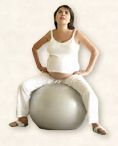
Swiveling on a birth ball stretches your legs and ankles as well as
everything else!
Start
you own program slowly and gently build your movements.
It's a
wonderful way to plan your day; a lovely personal time to acknowledge your blessings. Finding time to do important
things for yourself will give you a positive peace-of-being to share
with your family. Some Momma's think they really can't arrange
the time around the duties of caring for their other children.
Finding the time will give you more to give them than you
had before!
Happy Walking! Susan Oshel
Note:
Exercising after your baby is born should be set aside until six weeks postpartum. Recovering
after birth is another wonderful article! There are also times a
pregnant woman should avoid exercise during pregnancy.
The following conditions should be considered contraindications to
exercise during pregnancy:
Pregnancy induced hypertension
Pre-term rupture of membranes
Pre-term labor during the prior or current pregnancy or both
Incompetent cervix/cerclage
Persistent second or third trimester bleeding
Intrauterine growth retardation
In addition, women with certain other medical or obstetric
conditions, including chronic hypertension or active thyroid,
cardiac, vascular or pulmonary disease, should be evaluated
carefully in order to determine whether an exercise program is
appropriate.
Send
your questions to:
|