|
Charis Around
the World
Life In Ukraine
Anne
Sokol

Baby Maria's Birth
As a
doula, I just accompanied my first couple to a Ukrainian birth house
for the birth of their second child. In some ways, it was beyond
words, but I will try to write it out there.
First, I am so thankful to God for giving me the privilege,
knowledge, desire, and ability to serve families in this niche of
life. A birth that could’ve been a wretched, debilitating experience
was turned into a special memory, though colored with a bit of
horror.
Vitaliy and Natasha are the pastor and wife of our small church.
They have been attending my birth preparation classes, and they
asked me to be a doula for their birth. Doulas don’t really exist in
Ukraine yet, but I hope that changes. I desire that even more
earnestly after what I witnessed.
I first talked to Natasha about 7pm Tuesday night. I called her to
tell her not to go into labor yet because I didn’t have my nasal
streptococcus test results back yet (birth houses require a chest
x-ray (checking for active TB) and a nasal swab test checking for
streptococcus). Natasha told me that she had just been about to call
me because she thinks she’s starting labor. I asked her to try a warm
bath and see if things speed up or slow down.
At 9 pm, she calls me to say that contractions are about 15 seconds
long but spacing farther and farther apart. Don’t come. . . She
calls me back a little after 11pm that I need to come and we should
go to the birth house.
Their birth is planned to take place in birth house #3 where, as a
birth class, we had visited and asked lots of questions of the
midwife. We felt fairly comfortable about what we were getting into.
When I get to Natasha’s house, I just spend about an hour or so with
her, just watching, drinking tea, did some massage, a lot of talking
about this and that. She’s having small contractions but they aren’t
really too noticeable on the outside. I was hoping secretly that we
do quite a bit of the labor at home, but after an hour, Natasha
thought we should go. I doubted that we should go, but we talked
about it, and she wanted to go because they needed to stop at a
store and she wanted to get settled in. I decided to trust mom’s
instincts, let her be in control, and I saw that she was set on this
plan, so we needed to do it so she would be comfortable. But
mentally, I prepare myself for a 12-hour labor in a Ukrainian birth
house. It’s about 1am.
However, while we were walking down the stairs out to the car, she
stopped during her contraction. We waited, then continued. Hmmmm. We
went to a large store and walked around buying food for her birth
house stay and lots of chocolate to give the birth house workers.
She’s contracting, but still not too noticeable.
We drive to the birth house. It’s the dead of night, about 2:30 am.
We go to one door with a light on beside it. Vitaliy talks to the
lady thru the speaker---no, we need to go to the door on the right.
There are two more doors to the right; Vitaliy tries them all, but
we are always sent away saying we are at the wrong entrance. I’m
with Natasha contracting in the parking lot. He goes back to the
first door. Go to the RIGHT. We then understand that it’s the
speaker’s right and our left. We go to the main, darkened entrance. Vitaliy knocks loudly repeatedly. Finally a lady comes and tells him
to go around to the other side of the building (even farther
“right.”)
We do and finally get in the right place. Two personnel meet us,
check Natasha’s blood pressure, and we start hauling all our many
bags up to the fifth floor where the birth rooms are. This birth
house, like several here, are remodeled so that couples can labor
and birth in one room by themselves. Each room has a birth ball,
wide ladder, and a few other accoutrements.
Fifth floor. Yikes. We are greeted with unhappiness. Every birth
room is full, they are running around, maxed out. They put us in an
empty room with five beds in it and a sink. We start making
ourselves at home a little. The building in general is very Soviet. Concrete, dirty tiles, metal beds.
Natasha and I go to the bathroom—there is one toilet for all the
birthing women and their partners. None of the toilets I saw there
had seats on them. You squat on the rim or just hunch over without
sitting. A small trash can is beside the nasty toilet where we throw
out toilet paper (that we ourselves bring) and there are bloody
things in there.
The doctor, a tight-lipped lady, checks Natasha. “We’ll have a baby
soon,” is all she says. I ask how open she is. “6 centimeters. . . .
We need to break your water.” Natasha isn’t sure she wants her water
broken. But the doctor takes us all into another room with a small
exam table with stirrups. Natasha puts down her chux pad—you buy
your own and bring them all with you, also sterile gloves and any
other medical supplies.
Natasha is still questioning the water breaking, and I see we don’t
have much choice, so I say at 6 cm, it should be OK. She actually
only breaks the outer bag, so only a tiny bit of water and blood
came onto the chux pad. “We economize with these so take it back to
the room with you,” the doctor says.
I’m starting to get the idea about sanitation. She’s on a metal bed
with a mattress with some sheet thrown over it, and she lays on the
chux pad, too.
The doctor gets out her paperwork and starts asking Natasha
questions. Natasha is lying on the bed on her left side. I’m on my
knees beside her talking to her and massaging her back when she
wants it. She’s having harder contractions. The doctor asks her
questions. Natasha tries to answer. “How much weight have you
gained?” “17 kilograms.” (37 pounds) “Why did you gain so much
weight?” . . . . And on it goes. We have music playing, aromatherapy
scent, I’m talking/massaging Natasha through contractions (she liked
hard pressure on the sacrum), and Vitaliy is sitting by her on the
other side of the bed talking to the doctor. She asks about our
religion and how we differ from Orthodox (the main religion here).
They have a long conversation about that. I pray and talk and
massage and contract with Natasha. Things were going so fast.
Natasha wants a drink. We had been told before that eating and
drinking in labor was fine here. “No!” the doctor says immediately.
“If she has to have general anesthesia, she might throw up.” When
she leaves the room, we give Natasha a drink. Also, two things I had
with me were very important to her. One, I had bought her clear
lipstick for dry lips. She was ecstatic to have that. Second, she
asked for something cold. I had brought a purse-sized cooler with me
with two frozen water bottles in it. She loved holding that then
drinking the water.
At some point the doctor checks Natasha again. She’s having hard,
hard contractions, although not many—it all happens so quickly.
Vitaliy and I stroke her face and talk to her during the checks. No
information offered so I ask. “9 centimeters.” Soon Natasha tells me
she felt like pushing a little. I say to wait another contraction or
so to make sure. Two more contractions. “I’m pushing.”
I send Vitaliy to call the doctor who had just left. I tell her
Natasha wants to push. They have a birth room cleared out, so we
quickly move Natasha and all our stuff over there.
This next part is very hard for me to write about. I am crying.
Natasha is about to get on the bed and she asks a question about
position. The midwife says—side or back. She wants someone behind
her so I sit at the head of the bed. A crowd of about seven women
circle the bed.
All of what I’m about to describe takes place in about six
contractions—it’s fuzzy to me now. They tell her to push like she’s
pooping. I’m holding her head and shoulders trying to help her
breathe, telling her she’s great. During the contraction, the
midwife is attacking her vagina, pushing it back and open and sort
of digging out the baby’s head. It was so painful. Natasha was
instinctively pushing away from her, so she was on my lap kind of
falling off the bed.
The women around are all making horrible comments about what a bad
job she is doing, that they’ve never seen anything like this, and
how she needs to listen to them.
I get a clue. During contractions, I’m trying to help her breathe,
but when I see that they don’t want me interfering with their
“method,” I understand that trying to actually help Natasha birth
normally is not the thing to do. They will just intentionally hurt
her more and more if she tries to do anything other than what they
say. Vitaliy is standing on the other side of the bed comforting
her, too. I just stay in her ear, start telling her to push and
breathe (it actually wasn’t really hard pushing), and I am just in
shock at what I’m seeing. They mention her moving, that’s she’s
getting off the bed. I think if we should position her differently.
She says she’s fine and doesn’t want to move. I stay put.
The midwife keeps digging into her vagina at each contraction, and
when the head comes out, she’s pulling on it up and down and all
around and another lady next to me (who had deliberately stationed
herself there at Natasha’s fundus) does fundal pressure at some
point to get the baby out.
Sweet baby comes out and is put on Natasha’s chest (how modern) with
a blanket over her. They start messing with the placenta, digging
into Natasha’s uterus, tugging the cord, she’s crying out over and
over at the pain. Placenta finally out.
Then comes the vaginal check with the doctor. Two silver
shoe-horn-shaped things are put in either side of the vagina.
Natasha is in agony. I’m not positive, but I think the doctor pulls
out the cervix to check it. Then she digs around the vagina. A tear
has gone into the vagina (because she was behaving so badly, they
say). I am in shock, but just stick with comforting Natasha, telling
her she’s great, stroking her face, describing to her what the
doctor is doing exactly so she feels better.
She needs stitches. She asks for a shot of numbing stuff. They give
her Novocain because she didn’t think to buy her own
anesthetic---they don’t normally use that anymore they explain.
The doctor intends to stitch right away after the shot. Natasha asks
her to wait a bit so the place will numb. She waits a few minutes.
Natasha feels the stitching. Four stitches. I talk her thru each one
because she feels all the pain but doesn’t see what it’s from.
‘She’s putting another stitch in. . . Now she’s tying it . . . Now
she’s cutting the thread.” I keep telling her how great she is. We
are enjoying the baby. Vitaliy is being a rock.
After they all left, Natasha was still in her bloody chux, fluid
soaked night gown laying on the bed. The baby, Maria, had been born
at 4:30 am. We had arrived on the fifth floor at 3:00.
I start talking some. I explained that I don’t want the workers to
make her feel guilty for her birth, that they themselves behaved
very badly, emotionally and medically. I talked a little about how
dangerous it was what they did and that is was not normal or good.
Ukraine is a culture of control and shame-motivation. I didn’t want
them hurting my little family. I felt very protective of them. Once
when the midwife came back in, she mentioned again how Natasha had
torn because she’s behaved badly during the birth. They both looked
at me. The midwife’s back was to me. I rolled my eyes and shook my
head.

Vitaliy holding Maria in the birth room

The newborn table in the birth room.
When we’d visited before, the midwife we interviewed said we would
be moved downstairs to the room where Natasha and the baby would
stay two hours after the birth. We were together a long time in that
birth room. About four hours. We talked. We talked a lot. We got
through the shock of what they had done, we praised and thanked God
for giving us such a fast birth. They both were so grateful for my
presence. And you know, I made a difference. Having positive,
on-your-side support during that experience made a world of
difference for them, especially for Natasha. We made it into a happy
memory. That 30 minutes of the 2nd and 3rd stages is hard to think
about. But we talked about how great she had birthed, how fast, how
beautiful and cute Maria is (and she is!!!). We made pictures. And
they were together. Natasha breastfed a little and Vitaliy held his
daughter a long time. They had an edifying experience together
because a doula was there. I can imagine how horrible it could’ve
been, and usually is, without any other trained support.

The family in the birth room.
About
8:30 (four hours after birth) we were moved downstairs, Natasha on a
gurney. We settled her into a room with another lady/baby there. We
took off her nasty nightgown, and I washed her bloody bra and socks.
Things were much more peaceful here and everyone so much more
pleasant. A nurse came and a pediatrician and explained certain
things to do or not do. When I discovered no warm water
in the nasty shower, I washed her off with a cool washcloth and she
loved that. We stayed a long time, until noon or so. Made her
comfortable, ate, helped her get up to the bathroom. She wanted to
pee before we left, so she stood in the shower, and hot water had
come by that time so we washed off her lower body.
We made more photos. We held the baby. Changed meconium diapers,
rehashed more good and bad about the birth, but in this new place
and with the baby there, bad things faded more. She breastfed more.

The family in the new room where Natasha and the baby will stay for
a few days.
I drove
home with Vitaliy and another couple who came to pick us up. We were
analyzing the birth in the car, and the guy asked Vitaliy how he
felt about it. He said he was just so sorry for his wife, to see her
like that, knowing that if you try to intervene and protect her,
they will just hurt her more. That about summed up the horrible part
for me, too. But we made happy memories, too, and I think the happy
memories combined with a precious baby outshine the evil.
After
getting a little distance from this experience, I realize more and
more things as I ponder what happened. The experience in the birth
house reminds me of the movie, Anna and the King. I’ve watched and
analyzed that movie several times, and it resonates deeply with me
as a foreigner. It’s a story of culture clash. In small details and
overarching philosophies, two opposing cultures mix and both edify
and combust simultaneously.
I remember sitting on the bed holding Natahsa while she was pushing
and the birth house workers were all yelling at her. I see now that
we were trying to stand in two cultures, one was my culture of
support and comfort during birth. The other was a system of shame
and control and uncaring towards the mother. And in the clash of
cultures there was both edification and combustion.
Sometimes I question if I was guilty. (Is it something like
survivor’s guilt?) I ask myself, Did my presence somehow make her
birth worse? Would it have been easier for her to endure this if I
hadn’t been there? Would they not have treated her that way? Would
she more easily have “pleased” them somehow?
It gives me greater understanding of home birth midwives and home
birth advocates here. My friend Nadya is a dogmatic home birth
advocate. But I’ve doubted her. She lives in a smaller town with few
birth choices. Surely, I thought, in Kiev there are more modern
ideas now. Several birth houses have been praised to me as being so
great and changed and modern. This very birth house was praised to
me over and over about how wonderful and modern it is, about how you
can birth “in any position you want.” A man who works there told me
I could birth “like in America” there. What are they thinking? . . .
Now I understand Nadya.
I’m leaving soon to go talk to my next doula couple, also members of
our church, who also went with us to visit this birth house before
Natasha’s birth. The husband, Sergei, has already talked to Vitaliy.
I have some things I want to say while it’s fresh, too. I know they
won’t choose this birth house now, but another one? Will it be any
different? Will we hear about how great it is, then have the same
type of experience? Do they want to more seriously consider
homebirth? What is my role in all of this?
I feel like this trauma, too, was worse for me than for Vitaliy or
Natasha in some ways. Her pain was excruciating and the treatment
terrible. But now Natasha has a beautiful baby to hold and friends
and flowers. I feel like I’m left just with this terrible shock of
what I saw and experienced and no new baby to distract me. Vitaliy
witnessed it as I did, but even during the birth, I could tell he
didn’t understand how dangerously and horribly they were conducting
the birth. He didn’t know until later (when we processed the birth
together) how
bad it was. I’ve read a few times about terrible births like this
but now I’ve seen and experienced it.
I spoke
with a friend, (and former birth house doctor), about all I
witnessed. She validated that they were indeed pulling her
cervix out to check it after the birth. She explained that all the
vaginal and fetal manipulations, fundal pressure, cervix checking,
etc., that I witnessed were normal for birth here in Ukraine and
mandatory for the doctors to perform, even at the birth house.
It’s what they always do all over the country—it’s the written
protocol from the Minister of Health.
In the end, I’m glad I’m a doula. I love it. I don’t enjoy seeing
these things or being a part of them. But as a doula I made a huge
difference in a family’s health and happiness. I can’t wait ‘til I’m
a midwife and can help even more.
Love,
Anne Sokol
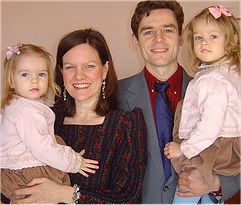
Victoria, Anne, Vitaliy and Skyla Sokol
Our International Charis
Family
Your stories from around the world touch us and we pray for your
safety.
Thanks, Love and Blessings to every one of you!

'Behold, I will bring them from the north country, And gather them
from the ends of the earth,
Among them the blind and the lame,
The woman with child and The one who labors with child, together,
A
great throng shall return there...And My people shall be satisfied with My goodness, says the LORD.'
Jeremiah 31:8, 14
~~~
©2009 Charis Childbirth
Services, All Rights Reserved
Feel free to forward this newsletter to friends in its entirety,
leaving all attribution intact.
April 2009
|