|
About Babies
Your Newborn
Baby’s Appearance
By Kristin Schuchmann
Newborn babies look a little strange immediately following birth. As
a birth professional, I didn’t think about how strange a newborn may
look, however, to someone who has never before seen a baby born,
until I attended a birth where a new father shared with me afterward
how scared he was when he first saw his baby. He said he thought his
baby was dead or had something terribly wrong with it. After a
discussion with this father, I realized that he assumed his baby
would look like the “Gerber Baby, but with a little slime on it.”
Because of that incident, I make it a priority to educate expectant
families as to what they can expect their baby to look like when it
is first born.
A baby’s head is made of soft, not yet fused together, skull bones
that enable it to compress as it emerges through the birth canal. As
the baby’s skull compresses to fit through the vagina, the skin will
bunch up, causing a wrinkled look to the crowning head as it
emerges. This is one thing that often alarms people as they witness
a birth for the very first time.
The other thing that may be disturbing is the color of the baby as
it is born. It isn’t unusual for a baby to look like a blue-gray
rubber doll as it is born. But, have no fear; as that baby takes his
first breath and cries, he will pink-up just fine.
The following is a description of other characteristics that can be
expected of a newborn baby:
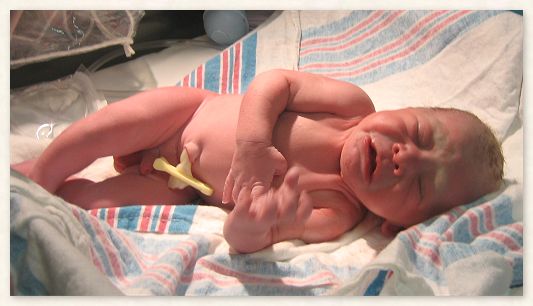
The Skin
· dry and thin, often revealing veins
· peeling, particularly on the hands and feet
· Until the baby starts breathing well, he often looks plum-colored
or blue-tinged. Sometimes a baby begins breathing well right at
birth and already has a pinkish skin tone– in fact, a fair-skinned
baby may look rosy-red.
· Black babies are fair-skinned until darker pigment settles
throughout their skin.
· VERNIX- the white, waxy substance on baby’s skin while in utero.
Early babies will have more vernix than on-time or late babies.
· birth marks
The Body
· short neck
· small, sloping shoulders
· swollen breasts
· large, rounded abdomen
· umbilical stump
· slender, narrow pelvis and hips
· LANUGO- downy, fine hair that may cover the back, shoulders,
forehead, and temples. It will fall out within the first few weeks.
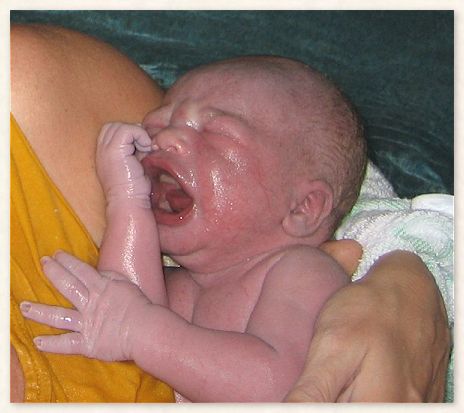
· When a newborn cries hard, a deep flush spreads over the entire
body. Often, veins on the head swell and throb.
The Eyes
· swollen
· may appear bloodshot
· Most black and Asian babies are born with brown eyes, and most
Caucasian babies are born with blue or slate-colored eyes.
· A newborn can’t focus both eyes beyond 8 to 10 inches, so he may
appear cross-eyed.
· The newborn will open eyes and look around if lights in the room
are dim. Bright lights hurt baby’s eyes. NO FLASH PHOTOGRAPHY for
the first couple of days.
The Head
· Usually seems too big for the body. It is about 1/4 of a baby’s
entire length.
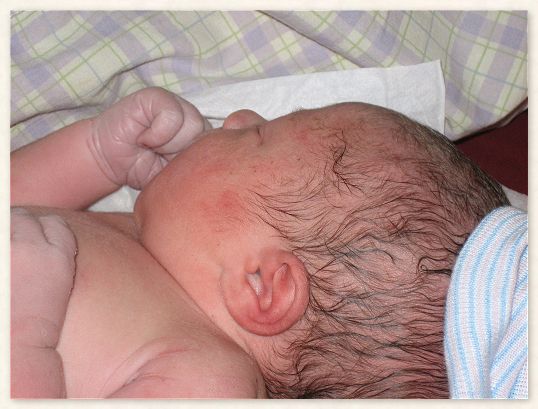
· May be lopsided or elongated due to the soft, not yet fully
joined, skull bones being compressed during birth. In a few days,
your baby’s head will become more rounded.
· Both a bald head and a thick crop of hair are normal.
· The skull has two soft spots, or FONTANELS, which you can feel and
may also be able to see. One is above the brow, and the other is
close to the crown of the head. Your baby’s pulse may be visible at
the fontanel on the top of the head.
· The scalp skin may be loose and the brow wrinkled.
The Face
· Flat nose and ears
· Chin may be pushed in or asymmetrical
· Will look more “normal” in a few days
The Hands
· Tight fists
· Finely lined palms
· Long, thin nails
· Dry, loose-fitting skin
· Deep, bracelet-like creases on the wrists
The Genitals
· Swollen due to maternal hormones
· Girls may have vaginal discharge which is usually clear or white,
but can be bloody. It will clear up in a few days.
The Legs
· Often drawn up against the abdomen in pre-birth position
· When extended, they are shorter than you would expect when
compared to the arms
· Usually a bit bowed. They will usually straighten out by the
time baby is walking
The Feet
· Made up of one bone, at the heel, and cartilage, which will form
future bones
· Loose, wrinkled skin
· Long, thin toenails
|