|
Pregnancy and
Birth
Weighing the
Pros and Cons of the Epidural
By Penny Simkin
The epidural block has been used increasingly over the past 50
years. Childbirth educators across the country are finding that more
and more women plan--even demand--an epidural in order to avoid
labor pain.
Why the popularity? Are there any significant disadvantages to
epidurals? Are they safe enough for routine use?
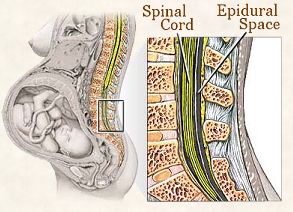
Risk Versus Benefit
There is almost always a trade-off when medications and
interventions are used during labor. Each woman must know and
consider the potential benefits and risks and apply them to her own
circumstances.
When the mother is managing her pain well and progress is normal,
the risks of an epidural outweigh the benefits. If, however, she is
exhausted, in extreme pain or requires painful interventions, the
benefits may outweigh the risks.
Potential Benefits of Epidurals
Epidural anesthesia or analgesia provides relief or reduction of
labor pain without affecting the mother's mental state. It enables
an exhausted mother to relax or sleep during labor and calms the
woman who is anxious and tense because of pain. Once an epidural
catheter is in place, additional medication can easily be
administered as needed, providing prolonged and consistent pain
relief.
Some prolonged labors, probably those slowed by anxiety, speed up
with an epidural. Anxiety can cause excessive production of the
mother's stress hormones such as epinephrine and norepinephrine,
which slow contractions. By allowing the mother to rest without
pain, the epidural removes her anxiety and her labor progress may
improve. If not, Pitocin may be administered painlessly. Since
epidurals often lower blood pressure, this may benefit some women
with pregnancy induced hypertension.
Epidurals are also useful for cesarean births, making it possible
for the mother to remain alert and involved while free from pain.
They enable her to avoid general anesthesia, which is considered to
carry greater risks.
Epidural narcotics reduce pain without reducing other sensations or
muscle function. Women can change positions more easily than with
anesthetics. They remain aware of their contractions and often
continue to participate; using breathing patterns and other comfort
measures. For those women who wish to remain aware of their labors,
epidural narcotics are often quite acceptable.
Potential Risks
Epidural blocks carry some risks to the mother, fetus and newborn.
Undesired effects tend to be greater with larger doses of
medication, a longer interval during which the medication is in
effect and immaturity or distress in the fetus.
Undesired
effects on the mother:
- Inadequate pain relief (up to 10%)
- Rise of the mother's oral and vaginal temperature, beginning
within one hour after administration of the epidural, which may lead
to treatment of the mother and baby for non-existent infection. This
effect may be dose-related. This recent finding from England is
being investigated in the United States.
- Drop in the mother's blood pressure treated with position changes,
oxygen and possible vasopressors (less likely if a bolus of IV
fluids is given before the epidural).
- Short or long-term postpartum backache from bruising caused by the
injection or from ligament strain caused by prolonged time spent in
a damaging position or inappropriate movement (for example, extreme
passive flexion of the mother's trunk, hips and knees during the
second stage, or sudden vigorous movements of the mother) while her
muscles are relaxed and her back is numb (up to 19%). Long-term
backache is almost twice as likely to occur with an epidural than
without.
- Possible unintentional spinal block and resulting spinal headache
requiring days of bed rest and a blood patch.
- Shivering may be reduced with lower doses, by warming of the
anesthetic before administration, or by adding narcotics to the
anesthetic.
- Mild to severe itching of the skin (with narcotics)
- Retention of urine, requiring a bladder catheter
- Mother feels detached from the process and becomes an observer;
others may reduce emotional support. The nurse can no longer assess
labor progress by observing the mother and must rely more on the
monitor and vaginal exams.
- Problems caused by human error or maternal structural anomaly,
such as inability to place catheter properly; inadvertent injection
of anesthetic into a blood vessel; or too much anesthesia, affecting
respiration and swallowing (rates vary with skill of the
practitioner and anatomy of the mother).
- Rare complications, such as residual numbness or weakness from
needle injury to nerves (almost 1 in 10,000), delayed respiratory
depression with epidural narcotics (up to 12 hours later), and brain
damage and death (extremely rare).
Undesired
effects on the labor:
- May slow labor, requiring Pitocin; and has been found to increase
the chances of a cesarean delivery in primigravidas by two or three
times.
- Often slows second stage by reducing or eliminating the normal
surge of oxytocin; and by reducing pelvic floor muscle tone, which
may lead to more deep transverse arrests or persistent occiput
posteriors. In addition, forceps or vacuum extractor are required
more often (20-75%). Delaying pushing until the fetal head is on the
perineum reduces the need for forceps. Even though this approach
lengthens the second stage, it does not increase the incidence of
fetal distress.
Undesired
effects on the fetus:
- Abnormal heart rate patterns, requiring oxygen to the mother,
position changes and possible cesarean delivery.
- Increased likelihood of newborn septic workup, IV
antibiotics and isolation in the nursery if the mother develops an
"epidural fever" that causes fetal tachycardia or newborn fever.
- If the fetus is already stressed greater amounts of the medication
are "trapped" in the fetal circulation, leading to more pronounced
newborn effects (see below).
Undesired
effects on the newborn:
- Short-term (six weeks or less) subtle neurobehavioral effects,
such as irritability and inconsolability and decreased ability to
track an object visually or to shut out noise, bright light.
There are no data on potential long-term effects.
- Possible less efficient or less organized initial rooting and
suckling behavior. Nurses have reported more difficulties in feeding
babies whose mothers had an epidural when compared to un-medicated
babies.
- Decreased infant responsiveness may lead to long-term consequences
for the parent-infant relationship. Parents should be
counseled to give their babies time to recover from the birth and
medication and should avoid a label of "difficult child" or
"incompetent mother."
Conclusion
The childbirth educator's duty is to inform, not to talk women into
or out of using an epidural. Many women will choose an epidural,
when well informed of benefits, risks and alternatives; others will
choose to avoid it if their labor allows.
When women are well informed, they will consider the information,
along with other factors - such as their fears, self-perceptions,
their goals for their birth experiences, their support system - and
make the most suitable decision.
References
1Dickersin, K. "Pharmacological Control of Pain During Labor." In:
Chalmers, I., Enkin, M., Keirse, M., eds, Effective Care in
Pregnancy and Childbirth. New York: Oxford University Press, 1989.
2Shnider, S.M., Abbound, T.K., Artal, R., Henriksen, E.H., Stefani,
S.J., Levinson, G. "Maternal Catecholamines Decrease During Labor
After Lumbar Epidural Anesthesia." American Journal of Obstetrics
and Gynecology 147(1):13-15, September 1983.
3Ramos-Santos, E., Devoe, L., Wakefield, M., Sherline, D., and
Metheny, W. "The Effects of Epidural Anesthesia on the Doppler
Velocimetry of Umbilical and Uterine Arteries in Normal and
Hypertensive Patients During Active Term Labor." Obstetrics and
Gynecology, 77(1):20-25, January 1991.
4Avard, D.M., and Nimroof, C.M. "Risks and Benefits of Obstetrical
Epidural Analgesia: A Review." Birth 12(4):215-225, Winter, 1985.
5Fusi, L., Maresh, M., Steer, P., and Beard, R. "Maternal Pyrexia
Associated With the Use of Epidural Analgesia in Labour." The
Lancet, 1250-1252, June 3, 1989.
6Reinke, C., Clinical Nurse Specialist at Virginia Mason Hospital,
Seattle Washington, Personal communication, June 1991.
7MacArthur, C., Lewis, M., Knox, E.G., and Crawford, J.S. "Epidural
Anesthesia and Long-Term Backache After Childbirth." British Medical
Journal, 301:9-12, July 7, 1990.
8Lui, W.H.D., and Luxton, M.C. "The Effect of Prophylactic Fentanyl
on Shivering in Elective Cesarean Section Under Epidural Analgesia."
Anaesthesia 46:344-348, 1991.
9McKay, S., and Roberts, J. "Obstetrics by Ear," American Journal of
Midwifery 35(5):266-273, Sept/Oct 1990.
10Scott, D.B. and Hibbard, B.M. "Serious Non-Fatal Complications
Associated With Epidural Block in Obstetric Practice." British
Journal of Anaesthesia, 64:537-541, 1990.
11Chadwick, H., Posner, K., Caplan, R., Ward, R., and Cheney, F. "A
Comparison of Obstetric and Nonobstetric Anesthesia Malpractice
Claims." Anesthesiology, 74(2):242-249, February 1991.
12Thorp, J.A., Parisi, V.M., Boylan, P.C., Johnston, D.A. "The
Effect of Continuous Epidural Analgesia on Cesarean Section for
Dystocia in Nulliparous Women." American Journal of Obstetrics and
Gynecology 161(3):670-675, September 1989.
13Maresh, M., Choong, K.H., and Beard, R.W. "Delayed Pushing with
Lumbar Epidural Analgesia in Labour." British Journal Obstetrics and
Gynaecology 90(7):623-627, July 1983.
14Lester, B.M., Als, H., Brazelton, T.B. "Regional Obstetric
Anesthesia and Newborn Behavior: A Reanalysis Toward Synergistic
Effects." Child Development 53:687-692, 1982.
This article has been reproduced with permission of Penny Simkin.

Penny Simkin, a physical therapist specializing in childbirth
education and labor support in Seattle, Washington,
is the author of The Birth Partner: Everything You Need to Know
to Help a Woman Through Childbirth
and co-author of Pregnancy, Childbirth, and the Newborn: A
Complete Guide for Expectant Parents.
|